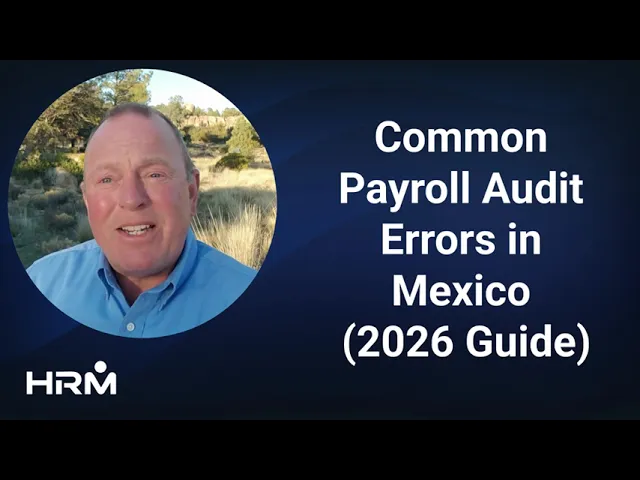
Common Payroll Audit Errors in Mexico (2026 Guide)
Learn the most common payroll audit errors in Mexico for 2026, including CFDI mistakes, tax miscalculations, IMSS issues, and audit risk triggers.
Questions about hiring in Mexico?
Get instant answers from our AI EOR Specialist — trained on Mexican labor law.
What Triggers Payroll Audits in Mexico
Payroll audits in Mexico are triggered when authorities detect inconsistencies between payroll, tax filings, and social security records. SAT and IMSS have independent audit powers and regularly cross-check employer data.
Payroll is considered a high-risk area because errors directly affect income tax, social security contributions, and employee benefits.
SAT audit authority
SAT audits payroll to verify correct income tax withholding, CFDI payroll issuance, and consistency between declared salaries and annual tax filings. Red flags include mismatched payroll CFDIs, incorrect taxable income, or differences between monthly and annual declarations.IMSS audit authority
IMSS audits focus on Contribution Base Salary (SBC), employee registration, and benefit integration. Common triggers include underreported salaries, incorrect integration factors, or late employee registrations that reduce social security contributions.Why payroll attracts audits
Payroll errors impact multiple obligations at once. A single mistake can affect ISR, IMSS, INFONAVIT, and employee entitlements. This makes payroll a priority enforcement area for authorities.Tax audits vs labor audits
Tax audits review financial compliance. Labor audits review employment conditions, benefits, and worker classification. Both can occur separately or together.
Payroll audits escalate quickly when errors repeat or appear systematic. Preventive compliance is the only effective defense.
Most Common Payroll Calculation Errors
Payroll calculation errors are one of the most frequent findings in Mexican audits. These mistakes usually come from applying non-Mexican payroll logic or misinterpreting how salary components must be calculated and integrated. SAT and IMSS treat repeated calculation errors as indicators of systemic non-compliance.
Incorrect salary and daily wage calculations
Many employers calculate daily wages using incorrect divisors or exclude mandatory elements. Monthly salary must always be converted using a 30-day base, regardless of calendar month length. Errors here affect income tax, social security, severance, and benefits calculations.Errors in overtime, bonuses, and commissions
Overtime must be calculated using legal multipliers and capped correctly. Bonuses and commissions that are paid regularly must be included in payroll and reflected in taxable income. Excluding recurring variable pay is a common audit trigger.Misapplication of benefits in the payroll base
Certain benefits must be integrated into the salary base for social security, while others are partially or fully exempt. Incorrectly excluding benefits such as bonuses, allowances, or incentives leads to underreported contributions and penalties.
Payroll calculation errors rarely stay isolated. Once identified, authorities typically expand the audit period and reassess multiple payroll cycles for consistency and legal accuracy.
Errors Related to 2026 Minimum Wage Updates
Minimum wage adjustments are one of the most common payroll audit triggers in Mexico, especially in years when rates change. On January 1, 2026, authorities expect employers to apply updated minimum wage rules immediately and consistently across payroll, tax, and social security reporting.
Failure to update minimum wage rates
Employers must apply the new minimum wage from the effective date set by law. Delayed updates result in underpayment of wages, incorrect tax withholding, and insufficient IMSS contributions. SAT and IMSS routinely cross-check payroll data to identify inconsistencies arising from outdated payroll configurations.Incorrect wage zone application
Mexico applies different minimum wage rates depending on the geographic zone. When employees perform work in the Northern Border Zone, a higher minimum wage may apply. Misapplying the general minimum wage in these cases can create compliance risks.
In practice, some interpretations determine the applicable wage zone based on the employer’s registered address rather than the employee’s physical place of work.Mismatch between actual pay and reported payroll
Paying employees correctly but reporting lower amounts in payroll CFDIs or IMSS filings creates serious compliance exposure. This mismatch signals intentional underreporting and often leads to expanded audits covering multiple years.
Minimum wage errors are considered objective violations. Once identified, authorities recalculate back wages, contributions, surcharges, and penalties across the affected period.
Payroll CFDI Errors That Trigger Audits
Payroll CFDIs are a primary audit reference for SAT. Every payroll payment must be supported by a correctly issued and stamped CFDI. When CFDIs are missing, incorrect, or inconsistent, audits are almost automatic because SAT cannot reconcile payroll tax data.
Missing payroll CFDIs
Each payroll payment requires a payroll CFDI issued in the same pay period. Paying salary without issuing a CFDI is treated as undeclared income. SAT cross-checks bank movements, expense deductions, and CFDIs to identify missing payroll records.CFDI timbrado failures
CFDIs that are generated but not properly stamped are considered invalid. Common causes include system errors, incorrect employee data, or expired certificates. Unstamped CFDIs provide no legal tax support and are flagged during electronic reviews.Duplicate or canceled CFDIs without replacement
Canceling a payroll CFDI requires issuing a correct replacement CFDI. Canceling without replacement creates payroll gaps. Duplicate CFDIs inflate salary records and distort tax and social security calculations.
CFDI errors are rarely treated as isolated mistakes. Once detected, SAT usually expands the review to confirm whether payroll reporting failures are recurring or systemic.
Incorrect Payroll CFDI Data and XML Errors
Even when payroll CFDIs are issued on time, data and XML structure errors frequently trigger audits. SAT systems validate payroll CFDIs automatically. Any inconsistency between employee data, catalogs, or XML structure is detected without manual review.
Wrong RFC or CURP
Each payroll CFDI must match the employee’s registered RFC and CURP exactly. Typos, outdated records, or mismatches with SAT databases invalidate the CFDI. These errors prevent proper tax attribution and are flagged immediately.Incorrect pay periods or dates
Payroll CFDIs must reflect the actual pay period and payment date. Using incorrect dates or overlapping periods creates inconsistencies between payroll frequency, bank payments, and tax filings. SAT treats this as unreliable payroll reporting.Invalid or outdated SAT catalog codes
SAT requires specific catalog codes for payroll concepts, deductions, and payment methods. Using deprecated or incorrect codes causes CFDI rejection or later audit findings. Catalog updates are mandatory and not optional.Structural XML errors
Improper XML structure, missing nodes, omission of the employee’s registered postal code or incorrect formatting make CFDIs technically invalid. These errors often occur when payroll systems are misconfigured or not updated.
Data and XML errors weaken payroll credibility. Once identified, authorities typically review all payroll CFDIs for systemic accuracy issues.
Errors in ISR Withholding and Payroll Taxes
Errors in income tax withholding are closely monitored by SAT because payroll is the main collection mechanism for ISR. When payroll tax calculations do not align with official tax tables or reported figures, audits are triggered quickly and often expanded.
Incorrect ISR withholding
ISR must be withheld based on the employee’s taxable income for each pay period. Common errors include using outdated tax tables, excluding taxable income components, or applying incorrect exemption thresholds. Under-withholding exposes the employer to tax differences, surcharges, and penalties.Mismatch between payroll and tax tables
SAT publishes official ISR tables that must be applied exactly as issued. Payroll systems that are not updated or manually adjusted often calculate tax using incorrect brackets. These mismatches are easily detected during electronic reviews.Errors in annual vs monthly tax reporting
Monthly payroll tax filings must reconcile with the annual employer tax return. Differences between cumulative payroll ISR and annual totals signal reporting inconsistencies. SAT treats these discrepancies as indicators of unreliable payroll controls.
ISR errors are rarely corrected voluntarily once detected. Employers should regularly validate payroll tax calculations using reliable tools such as the Mexico ISR Calculator available at https://www.payrollmexico.com/mexico-isr-calculator.
Payroll tax inconsistencies often lead to deeper reviews across multiple fiscal years.
IMSS, INFONAVIT, and SAR Contribution Errors
Social security contribution errors are among the most costly payroll audit findings in Mexico. IMSS, INFONAVIT, and SAR contributions are calculated using the same salary base, so a single mistake affects multiple institutions at once. Authorities routinely cross-check these filings against payroll CFDIs.
Incorrect contribution base (SDI)
The salario diario integrado must include mandatory benefits such as vacation bonus and Christmas bonus, plus any regularly paid variable income. Excluding required elements or using outdated integration factors results in underpaid contributions and automatic recalculations.Underreporting or overreporting wages
Reporting lower wages to reduce contributions is a common audit trigger. Overreporting also creates compliance issues, as it inflates employer costs and distorts employee benefit entitlements. Authorities verify reported wages against payroll CFDIs and bank payments.Late or incomplete social security payments
IMSS, INFONAVIT, and SAR payments must be made within strict deadlines. Partial payments, missed months, or late filings generate surcharges and fines. Repeated delays signal weak payroll controls and increase audit risk.
Contribution errors are rarely treated in isolation. Once identified, authorities typically reassess historical periods and recalculate differences, penalties, and interest across all affected contributions.
State Payroll Tax Errors
State payroll taxes are often overlooked by foreign employers because they are separate from federal payroll obligations. Each Mexican state imposes its own payroll tax, and state authorities actively audit employers for registration, calculation, and payment compliance.
Failure to register at state level
Employers must register for payroll tax in the state where employees physically perform their work. Not having a local entity does not remove this obligation. Operating without registration is treated as tax evasion at the state level.Incorrect tax rate application
Payroll tax rates vary by state and may change through local legislation. Applying a uniform rate across all employees or using outdated rates results in underpayment or overpayment. State authorities verify rates against declared payroll bases.Late or missing state payroll tax filings
State payroll tax returns have strict filing deadlines. Late filings trigger fines, surcharges, and interest. Missing filings often result in estimated assessments based on payroll data obtained from federal authorities.
State payroll tax errors often surface after federal audits. Once identified, states reassess prior periods and impose penalties that are separate from SAT or IMSS sanctions.
Worker Misclassification Errors
Worker misclassification is one of the highest-risk payroll compliance issues in Mexico. Authorities closely monitor whether individuals labeled as contractors are actually operating under an employment relationship. Misclassification almost always results in full payroll reassessment.
Treating employees as contractors
In Mexico, independent contractors cannot work under subordination. When an individual provides services exclusively, follows schedules, and receives ongoing payments, the relationship is presumed to be employment. Labeling such individuals as contractors does not change the legal reality.Incorrect use of outsourcing structures
Labor outsourcing is strictly regulated. Using third-party arrangements to avoid payroll obligations is illegal when the services are part of the company’s core business or when the client already has a legal entity. These structures are a common audit focus.Subordination indicators ignored
Authorities assess who controls the work, schedules, tools, and performance. Ignoring these indicators leads to reclassification. Once subordination is established, payroll taxes, social security contributions, and benefits are recalculated retroactively.
Misclassification findings are rarely limited to one individual. Audits typically expand to review all similar arrangements, resulting in significant back payments, penalties, and legal exposure for the employer.
Errors in Perceptions and Deductions Reporting
Errors in how perceptions and deductions are classified and reported are common audit findings in Mexico. SAT and IMSS review whether income and benefits are correctly categorized for tax and social security purposes. Inconsistent treatment raises immediate compliance concerns.
Misclassification of taxable vs non-taxable items
Certain perceptions are fully taxable, partially exempt, or non-taxable only within legal limits. Employers often apply exemptions incorrectly or assume benefits are non-taxable without legal basis. This results in underreported ISR and social security differences.Incorrect benefit treatment
Benefits such as bonuses, allowances, and incentives must be treated according to their frequency and purpose. Regular payments are often required to be included in taxable income and the contribution base. Incorrect treatment leads to recalculations during audits.Inconsistent reporting across systems
Payroll systems, accounting records, CFDIs, and IMSS filings must align. When the same concept is treated differently across systems, authorities interpret this as weak internal controls. Cross-system inconsistencies are easy for auditors to detect.
Reporting errors in perceptions and deductions often lead to expanded audits. Authorities typically review multiple periods to confirm whether misclassification is recurring or systemic.
Payroll vs SAT and IMSS Data Mismatches
Mexican authorities rely heavily on automated cross-checks between payroll records, SAT filings, and IMSS databases. When reported data does not align across systems, audits are triggered with minimal discretion.
Differences between internal payroll and SAT records
SAT compares payroll CFDIs, monthly tax filings, and annual returns. Differences in reported salaries, taxable income, or withholding amounts indicate reporting errors or incomplete payroll disclosure.IMSS wage discrepancies
IMSS verifies the salario diario integrado reported for each employee against payroll CFDIs and benefit data. Discrepancies suggest underreported contributions or incorrect benefit integration. These cases often result in retroactive assessments.Reconciliation failures
Employers are expected to reconcile payroll, tax, and social security data regularly. Failure to reconcile leads to cumulative discrepancies over time. Authorities view unreconciled data as evidence of weak payroll controls.
Data mismatches rarely resolve themselves. Once identified, authorities typically expand the audit scope to assess historical periods and confirm whether inconsistencies are isolated or systemic.
Failure to Use SAT Payroll Review Tools
SAT provides payroll review tools that allow employers to see exactly how payroll data is recorded and interpreted by tax authorities. Failing to use these tools is a common compliance mistake that leads to preventable audits.
Not reviewing the SAT payroll viewer (visor de nómina)
The visor de nómina shows how payroll CFDIs are aggregated for each employee and reporting period. Employers who do not review this tool often miss errors in taxable income, deductions, or reported wages that SAT already considers final.Ignoring SAT data warnings
SAT issues electronic alerts when inconsistencies are detected between payroll CFDIs, tax filings, or employer declarations. Ignoring these warnings signals non-compliance. Unaddressed alerts often escalate into formal audit procedures.Uncorrected discrepancies
When discrepancies are identified, employers are expected to correct them promptly through CFDI corrections or amended filings. Leaving known errors unresolved increases penalties and strengthens SAT’s position during audits.
SAT payroll tools are not optional monitoring systems. They represent SAT’s official view of employer payroll data. Employers who actively review and correct issues reduce audit exposure significantly and demonstrate good-faith compliance practices.
Recordkeeping and Documentation Failures
Strong payroll records are essential during audits in Mexico. Even when calculations are correct, missing or incomplete documentation creates compliance exposure. SAT and IMSS place a high burden of proof on employers.
Missing payroll records
Employers must retain payroll calculations, payment support, and tax working papers. Missing records prevent verification of compliance and often result in authorities estimating liabilities in favor of the government.Poor CFDI storage and retention
Payroll CFDIs and their XML files must be stored securely and be readily available. Losing XML files or relying only on PDFs is insufficient. Authorities require access to original electronic files during audits.Incomplete employee documentation
Employee contracts, registrations, salary changes, and benefit records must be complete and consistent. Missing or outdated documents weaken the employer’s defense during labor or tax reviews.
Documentation failures often shift the audit burden entirely to the employer. Without proper records, authorities assume non-compliance and apply recalculations, fines, and penalties accordingly.
Timing and Deadline Errors
Timing errors are treated seriously in Mexican payroll audits because deadlines are legally defined and strictly enforced. Even when amounts are correct, late compliance is considered a violation.
Late payroll payments
Salaries must be paid on the agreed payroll schedule. Delayed payments create discrepancies between payment dates and payroll CFDIs. SAT and labor authorities treat repeated delays as poor payroll control and potential labor violations.Late tax filings
Monthly ISR filings and employer tax declarations have fixed deadlines. Late filings generate automatic surcharges and interest. Repeated delays increase audit risk and signal non-compliance to SAT systems.Late social security contributions
IMSS, INFONAVIT, and SAR contributions must be paid within statutory timeframes. Late payments trigger penalties and interest, even if the full amount is eventually paid. Authorities track payment history closely.
Timing violations often compound quickly. Once a pattern of late compliance is identified, audits typically expand to verify whether delays affect multiple payroll periods and obligations.
Consequences of Payroll Audit Errors
Payroll audit errors in Mexico carry significant financial and operational consequences. Once authorities identify non-compliance, penalties are applied retroactively and often trigger ongoing monitoring.
SAT fines and penalties
SAT imposes fines for incorrect ISR withholding, missing or invalid payroll CFDIs, and inaccurate tax reporting. Penalties increase when errors are repeated or considered intentional. Interest and surcharges apply from the original due date.IMSS and INFONAVIT surcharges
IMSS and INFONAVIT recalculate unpaid contributions, apply surcharges, and impose fines. Employers must also pay updated contributions plus interest. These assessments can cover multiple years once an audit is opened.Loss of payroll tax deductibility
Payroll expenses that are not properly supported by valid CFDIs or timely tax payments may be disallowed as deductible expenses. This increases corporate tax exposure beyond payroll itself.Increased audit frequency
Employers with payroll findings are often flagged for future reviews. Once identified as high risk, audits may occur more frequently and with a broader scope.
Payroll audit consequences extend beyond fines. They disrupt operations, increase compliance costs, and expose employers to prolonged regulatory scrutiny.
How to Reduce Payroll Audit Risk in Mexico
Reducing payroll audit risk in Mexico requires proactive controls and continuous oversight. Authorities expect employers to detect and correct payroll issues before they escalate. Reactive corrections after an audit starts rarely reduce penalties.
Regular payroll reconciliations
Employers should reconcile payroll calculations, CFDIs, tax filings, and IMSS data every pay period. This ensures consistency between internal payroll, SAT records, and social security contributions. Reconciliations help identify errors early and limit exposure.Internal payroll audits
Periodic internal reviews allow employers to verify salary calculations, ISR withholding, benefit integration, and contribution bases. These audits should follow Mexican legal rules, not global payroll standards. Internal audits reduce the likelihood of systemic errors.Continuous compliance monitoring
Payroll rules change regularly. Monitoring updates to tax tables, minimum wages, SAT catalogs, and social security rules is essential. Payroll systems and processes must be updated immediately when changes occur.
Payroll audit risk is manageable when compliance is treated as an ongoing process. Consistent controls, accurate reporting, and timely corrections significantly reduce exposure to audits and penalties.
Why Foreign Companies Rely on Human Resources Mexico (HRM)
Foreign companies rely on Human Resources Mexico (HRM) because payroll compliance in Mexico requires a real legal employer with physical presence and deep local expertise.
HRM operates as the sole legal employer in Mexico, not a platform or intermediary, ensuring payroll is managed under Mexican law from day one.
HRM as the real legal employer in Mexico
HRM is a REPSE-registered Employer of Record with over 16 years of physical operations in Mexico. Employees are legally hired by HRM, eliminating co-employment risk and ensuring full alignment with Federal Labor Law. This structure removes ambiguity around employer responsibility during audits.Payroll aligned with SAT and IMSS requirements
HRM payroll processes are built around SAT, IMSS, INFONAVIT, and SAR rules. Payroll CFDIs, ISR withholding, contribution bases, and reporting are handled locally, using Mexican compliance logic rather than global payroll assumptions.Full responsibility for payroll compliance and audit readiness
HRM manages payroll calculations, filings, reconciliations, and documentation. Audit readiness is built into daily operations, reducing exposure to penalties and reassessments. Clients companies focus on business operations while HRM controls payroll compliance.
Foreign companies entering Mexico face immediate payroll risk without local expertise. HRM provides legal certainty, operational continuity, and audit-resilient payroll execution.
If you are hiring in Mexico without a local entity, HRM acts as your legal employer and manages payroll compliance end to end, ensuring SAT and IMSS audit readiness from the first hire.
Want to hire in Mexico and stay compliant?
Reach out to us and get a proposal tailored to your hiring needs.
FAQs
What is the most common payroll audit error in Mexico?
The most common payroll audit errors involve incorrect salary calculations, missing or invalid payroll CFDIs, and mismatches between payroll, SAT, and IMSS data. Authorities treat these issues as systemic risks because they affect taxes, social security contributions, and employee benefits at the same time.
Can SAT and IMSS audit payroll at the same time?
Yes. SAT and IMSS have independent audit authority and often conduct parallel or consecutive audits. SAT focuses on tax compliance and CFDIs, while IMSS reviews contribution bases and employee registration. Findings from one authority are frequently shared with the other.
Are payroll audits triggered automatically in Mexico?
Many payroll audits are triggered automatically through electronic cross-checks. SAT systems compare payroll CFDIs, tax filings, and bank data. IMSS systems compare reported wages and contribution bases. Discrepancies identified electronically can trigger audits without prior warning.
How long can authorities review payroll records?
Authorities can review payroll records for multiple prior years, depending on the type of audit and findings. When errors are identified, audits often expand to earlier periods to confirm whether issues are isolated or repeated across several payroll cycles.
How does using an EOR reduce payroll audit risk?
Using a compliant Employer of Record reduces audit risk by centralizing payroll responsibility under a single legal employer. A local EOR applies Mexican payroll rules correctly, maintains documentation, and ensures ongoing compliance with SAT, IMSS, and INFONAVIT requirements.
AI-Powered
What can the Mexico EOR Specialist Answer
Ask about any area of Mexican employment law — get instant, verified answers.
EE Contracts
Indefinite vs. temporary, probation periods, remote work laws, foreign nationals
Benefits & Compensation
Aguinaldo (Christmas bonus), PTU profit sharing, minimum wage 2026, overtime rules
Vacations & Exits
Vacation days table 2026, severance calculation, resignation vs. termination rules
Compliance & Risk
REPSE requirements, NOM-035, IMSS social security, payroll taxes, termination risks